

Five-Step Intervention Cycle: Conflict Management Vignette
The following five-step intervention cycle can be applied when teaching a student to apply specific strategies that lead toward a desired outcome. Throughout this guidance, a vignette is included to illustrate how to structure and implement individualized interventions for conflict management. Review the Conflict Management Infographic for the research base and associated student outcomes. For each step, students should provide input and be empowered to whatever extent is possible. Additionally, while we illustrate connections to the Individualized Education Program (IEP), the steps apply to planning interventions for any student.
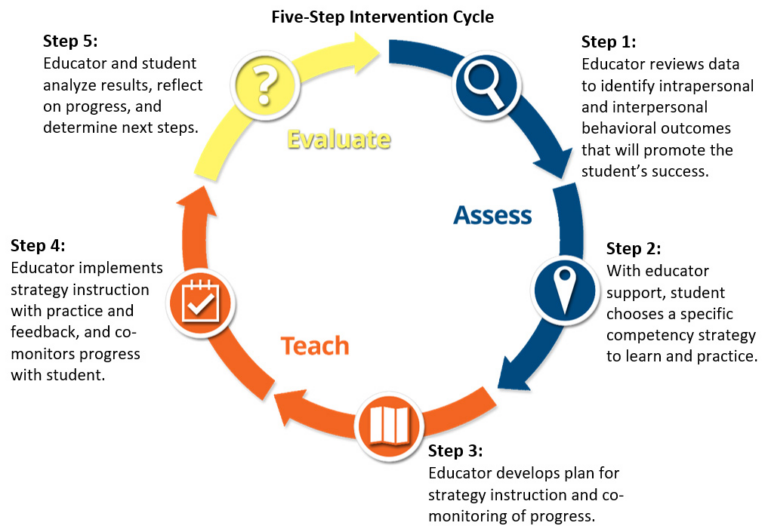
Step 1: Educator reviews data to identify intrapersonal and interpersonal behavioral outcomes that will promote the student’s success.
Every person has a wide range of intra- and interpersonal skills that they are working to refine. With this first step, we review data from various sources (e.g., our own observations, student self-assessment, and family input) to identify a desired behavioral outcome that will help the student better engage in learning.
Some examples of desired behavioral outcomes include:
- [Name] chooses effective conflict management responses when participating in cooperative learning.
- [Name] thinks through their response when frustrated with peers.
- [Name] listens to others and summarizes their perspective during group work.
- [Name] shares their ideas when participating in cooperative learning.
- [Name] negotiates solutions to conflicts.
- [Name] determines underlying feelings and applies self-calming techniques when angry or frustrated.
While educator observation alone can identify a desired student outcome, additional data from students and families can help to increase buy-in and target areas for growth. Common data sources include student input, family input, educator observation, and school behavior data. We’ll discuss each of these data sources.
Student Input. The College & Career Competency Framework curricula incorporate student reflection measures (K–12) and knowledge assessments (intermediate and secondary levels) for all four foundational competencies (i.e., assertiveness, conflict management, self-efficacy, and self-regulation). These assessments illustrate student input for easy-to-interpret results which can be discussed with students. Assessment technical guides at www.cccstudent.org outline each student assessment and provide instructions for administering and interpreting the results. Download and reference the Conflict Management Assessment Technical Guide.
Family Input. The Skills That Matter: Family Reflection asks parents to reflect on their child’s demonstration of intra- and interpersonal behaviors. Conflict management items include:
- When my child feels angry, they think about what they want to say before they say it.
- During a disagreement, my child listens to others’ thoughts and feelings.
- When my child has a disagreement, they try to work it out so everyone feels better.
- If two friends are arguing, my child tries to help them understand each other.
- My child can explain various ways to respond to a disagreement.
This reflection can be completed online (see www.cccstudent.org for assessment details) with results that are easily interpreted and can be discussed with the family and student.
Educator Observation. Educators structure their assessment of the student through competency-specific performance-based observations. Data from performance-based observations provide both a baseline and a mechanism for measuring growth over time. Protocols for performance-based observations are included in the College & Career Competency Framework curricula, and data can be entered and illustrated online (see www.cccstudent.org).
School Behavior Data. Behavioral data also support prioritization of intra- and interpersonal skills. Such data may include office disciplinary referrals, attendance, on-time homework completion, behavioral universal screening, and engagement in learning.
Let’s walk through an example for our student, Katie, who is strong academically. Her assignments are completed on time, and they are high quality. She engages in new learning and enjoys challenging work, but while working with a partner or in small groups, Katie frequently becomes frustrated and angry. She has raised her voice at her peers, refused to let them share ideas, and completed the entire group’s work on her own. When her teacher asked her to explain why working with others was challenging, Katie said, “My classmates aren’t as smart as me, and it’s easier to do all the work myself.” Her behavior toward others has resulted in her peers asking to work in another group or refusing to work with Katie.
Katie’s class is learning conflict management, and her self-reflection questionnaire shows that she answered Not Very Like Me to the following statements:
- When I experience a conflict, I think about reasons the conflict happened, including possible misunderstandings.
- I try to understand the other person’s point of view during an argument.
- When I experience a conflict, I work with the other person to decide what we should do next.
Katie’s grandmother completed the Skills That Matter: Family Reflection and rated conflict management indicators as her lowest areas. Specific items rated as Not Like My Child included:
- When my child feels angry, they think about what they want to say before they say it.
- During a disagreement, my child listens to others’ thoughts and feelings.
- When my child has a disagreement, they try to work it out so everyone feels better.
Student records show that Katie’s attendance is good but that she has several disciplinary referrals for her treatment of others. Her teachers report that Katie is well-behaved except when she is asked to work with others. She often dominates class discussions and if given a choice will choose to work on her assignments alone.
Katie’s teachers rated her proficiency on conflict management behaviors on the Conflict Management Performance-Based Observation. Indicators for which Katie’s behavior was rated at the Beginning stage (not yet able to demonstrate without scaffolding) included:
- Anticipates outcomes when different conflict management styles are applied to various situations (Strategy 2, pause and ponder).
- Demonstrates understanding the context of conflicts, including the perspectives of all involved (Strategy 4, uncover reasons for the disagreement).
- Applies appropriate conflict management approaches to situations based on desired outcomes (Strategy 8, plan my response).
- Demonstrates negotiation and mediation strategies in conflict situations (Strategy 9, find a solution; Strategy 10, help others find solutions).
After reviewing the data, Katie’s teacher identified the desired behavioral outcome: Katie will collaborate with peers by sharing her ideas, listening to the ideas of others, and reaching consensus on group decisions.
To summarize, Step 1 focuses on reviewing data to identify behavioral outcomes that will promote the student’s success. Data from educator observations and other available sources are reviewed to determine the desired student behavioral outcome. If the intervention is part of a student’s IEP, a synopsis of the data is added to the Present Level of Academic Achievement and Functional Performance (PLAAFP) section.
Step 1 Task List:
- Gather and review intra- and interpersonal data.
- Identify the desired student behavioral outcome.
Step 2: With educator support, student chooses a specific competency strategy to learn and practice.
In Step 2, educators consider the data gathered in Step 1, prioritize one competency which is likely to lead toward the desired behavioral outcome, and review the ten strategies for that competency (i.e., assertiveness, conflict management, self-efficacy, self-regulation). While the competency is chosen by the educator, to best impact the desired behavior, the competency strategy should be selected by the student, with support if needed.
The educator and student discuss the student’s strengths and the desired behavioral outcome from Step 1. Then they discuss the strategies for the targeted competency, and the student identifies one strategy for focus (e.g., explore conflict responses, pause and ponder, seek to understand perspectives). While several competency strategies may emerge as important, the student should begin with focusing on one strategy. With educator support, the student then creates an I-statement, articulating the strategy they will learn and the situation in which they will apply the learning.
Some examples of student I-statements for building conflict management include:
- When conflicts arise during group work, I will explore conflict responses before reacting.
- I can pause and ponder my response before engaging with adults who appear frustrated or angry.
- I will voice my perspective during cooperative learning.
- I can seek to understand perspectives during cooperative learning.
- When I have a disagreement with my friends, I will try to find a solution.
- I will manage my anger by thinking about my feelings and applying self-calming techniques.
Katie’s self-reflection, the family assessment, and behavior data show a priority for the interpersonal competency conflict management. In a discussion with her teacher, Katie explains that she is frequently frustrated by other students and doesn’t enjoy working with them.
Katie’s teacher shares some of her strengths, including that she puts forth effort in completing her assignments and is accepting of challenging work. The teacher then shares the desired behavior outcome: Katie will collaborate with peers by sharing her ideas, listening to the ideas of others, and reaching consensus on group decisions. They review the Conflict Management Strategies, and Katie determines she could benefit from focusing on seeking to understand perspectives. With support from her teacher, Katie writes a conflict management I-statement:
I can seek to understand perspectives when I am working in a group [Conflict Management Strategy 6].
Interventions do not replace classroom instruction—interventions are additional instruction and support specially designed to meet a student’s needs. Class-wide instruction should continue to guide all students in learning and practicing intra- and interpersonal strategies. Additionally, when classroom issues emerge, class-wide reteaching and guided practice (sometimes referred to as class-wide interventions) will support all students. For example, if you hear students disagreeing over the outcome of a situation, focus on teaching the strategy find a solution and helping students understand how it will benefit them. A class-wide We-statement might be When we disagree about the outcome of a situation, we will find a solution by listening to each other’s ideas and agreeing on the next steps.
As mentioned earlier, Katie’s class is learning Conflict Management Strategies. Katie’s teacher plans to continue to guide students in all strategies, but she wants to focus class-wide on the strategies voice my perspective and listen and summarize. She posts the We-statement on the board: We will voice our perspectives respectfully and listen and summarize others’ ideas during group work. When assigning long-term group work, the teacher plans to guide a short discussion about why voicing your perspective respectfully is important. She also plans to have students practice listening and summarizing each other’s ideas before they begin working in a group. This will help all students continue to make progress toward their goals and help Katie as she works to seek to understand perspectives while working with others.
Step 2 Task List:
- Facilitate student reflection on their strengths and challenges.
- Support the student to identify one competency strategy for focus.
- Guide the student to determine how the competency and strategy apply to them personally by determining the situation in which they will use the strategy.
Step 3: Educator develops plan for strategy instruction and co-monitoring of progress.
In Step 3, educators think through how they will teach the student the competency strategy. Like any content, students learn strategies through a process of initial instruction, guided collaborative learning, and independent practice with feedback. This step also includes creating ways to co-monitor student progress, such as student logs and daily check-ins. When planning to teach a competency strategy, educators need to consider skill acquisition, skill performance, skill fluency, and the environmental contexts that promote the skill. We’ll discuss each of these elements.
Skill Acquisition. First the student must learn the strategy—what it looks like, how to do it, when to use it. If we look at Katie’s I-statement, we’ll need to create a process in which she learns techniques for seeking to understand perspectives. She also needs to notice when she isn’t considering others’ ideas or perspectives and change her behavior to include listening and asking questions to help her understand others. The Conflict Management Lessons include numerous instructional activities that teach students the strategy seek to understand perspectives (see the Conflict Management Activity Crosswalk). Similar instruction guides are available for assertiveness, self-efficacy, and self-regulation.
Skill Performance. The student will need guided practice of the strategy with skill demonstration. At this practice phase, the student requires modeling and prompting. For example, Katie could be prompted each day to try different listening techniques (e.g., taking notes, identifying key points, looking at the person who is talking). She could also write a list of questions to use when asking for clarification. Even as she becomes more independent, this guided practice can help her hone the skill.
Skill Fluency. A skill isn’t a competency until we can apply the strategy when we need it. For Katie, once she consistently uses techniques to help her listen and consider others’ ideas and can summarize them without being prompted, she is fluent in the skill. This is easier said than done. Think of it this way—we know what healthy eating looks like, but we still often make choices that don’t fit our own definition of healthy eating. All behavior changes are challenging, and perfection isn’t the standard that we should hold ourselves to. Incorporating student self-monitoring will increase the student’s ownership and build the student’s ability to apply other strategies in the future.
To build Katie’s skill fluency, we can help her set up a daily log where she reflects on the techniques she used to listen and understand the perspective of others (see the Strategy Log Template). Adults can provide prompts and model the techniques. Katie’s teachers can also provide reinforcement by noting when Katie is demonstrating seeking to understand perspectives and by praising her effort and progress as she practices. Daily check-ins and reflection will help Katie be more aware of her progress.
Skill fluency should also be monitored through performance-based observation and other performance metrics. For Katie, these metrics might include teacher observation, peer reflection on group dynamics, group project completion, and fewer teacher prompts. Katie’s teacher can reflect on Katie’s strategy use at the end of each week by determining Katie’s level of independence on the performance-based observation rubric.
Environmental Contexts. The environment can promote strategy performance and fluency, or it can hinder independence. We’ll talk more about fidelity of implementation in the next section, but at the planning stage, we need to make sure that the educators are on board and that the environment is conducive to the planned intervention.
For example, as Katie practices considering others’ thoughts and ideas, she may determine that she will take notes on what they have said. For some tasks, like a quick Think–Pair–Share, this behavior may not be appropriate, because it takes too long.
Part of skill development is helping Katie learn the techniques that are appropriate in each environment. Educators can support individual students in applying the techniques and may even find that guiding all students in learning to summarize the ideas of others is beneficial.
To help notice the incremental learning and application, consider outlining benchmarks of progress. For Katie’ s I-statement, benchmarks might include:
- Katie describes how to seek to understand perspectives.
- Katie describes how seeking to understand perspectives will help her.
- Katie explores techniques for active listening and uses them when prompted.
- With prompting, Katie self-selects a listening technique and determines its effect.
- Katie increases her independence in seeking to understand perspectives during group work.
- Katie demonstrates increased collaboration with others during group work.
- Katie progresses in seeking to understand perspectives as measured by
- self-monitoring completed by Katie daily and discussed with interventionist (daily check-ins until she reaches the skill fluency stage and then weekly check-ins) and
- performance-based observations conducted by the classroom teachers every week until Katie reaches the skill fluency stage.
Step 3 Task List:
- Plan the instructional process, including skill acquisition, skill performance, skill fluency, and environmental contexts.
- With the student, plan how the student will log strategy use and debrief with an adult.
- Outline how incremental progress will be monitored.
Step 4: Educator implements strategy instruction with practice and feedback, and co-monitors progress with student.
In Step 4, educators focus on providing quality competency instruction on the strategy. Over time, they facilitate student understanding of the competency strategy, guide practice, prompt strategy use in authentic environments, and provide feedback. Throughout the instructional process, educators co-monitor progress with the student and facilitate reflection while reteaching as necessary. In short, in Step 4, you take the actions that you planned in Step 3.
For Katie, her use of seeking to understand perspectives is monitored daily and weekly. Daily within the skill acquisition and skill performance stages, Katie meets with the teacher or trained adult at the beginning of her day to brainstorm possible situations in which she might find herself seeking to understand perspectives. The teacher prompts Katie to practice seeking to understand perspectives by making eye contact, using listening techniques, and asking questions to clarify understanding. They meet again at the end of the day to review her log and discuss challenges. This check-in is completed alongside skill development instruction.
Weekly, Katie’s teacher reflects on Katie’s strategy use by determining Katie’s level of independence on the performance-based observation rubric. Together, Katie and her teacher determine completion of each benchmark, reflect on progress, discuss adjustments, and reteach when needed.
- Katie describes how to seek to understand perspectives.
- Katie describes how seeking to understand perspectives will help her.
- Katie explores techniques for active listening and uses them when prompted.
- With prompting, Katie self-selects a listening technique and determines its effect.
- Katie increases her independence in seeking to understand perspectives during group work.
- Katie demonstrates increased collaboration with others during group work.
As needed, the teacher may adjust the environment or classroom rituals to support the student’s strategy development. For example, at the beginning of class, the teacher might guide all students in one method of seeking to understand perspectives. Or the teacher might create more small-group activities, which allow students to practice seeking to understand perspectives.
Step 4 Task List:
- Provide instruction that facilitates student understanding of the strategy.
- Guide practice in the strategy over time in authentic environments.
- Provide feedback to the student throughout their practice of the strategy.
- Co-monitor progress with the student and facilitate reflection.
- Reteach as necessary.
Step 5: Educator and student analyze results, reflect on progress, and determine next steps.
In the final step, the student has learned and practiced the strategy and can demonstrate it in the context outlined in the student’s I-statement. It is time to celebrate progress. Educators support the student in articulating what they have learned and how the strategy has helped them. The teacher and student review data together that demonstrate this progress.
Katie reflects on her I-statement, I can seek to understand perspectives when I am working in a group [Conflict Management Strategy 6]. She describes how she is able to listen to others’ ideas most of the time now. Katie explains techniques that work well for her, including taking notes while listening to others, making eye contact, and asking questions to help her understand others’ thoughts or ideas.
Next, the teacher and student identify supports to help the student sustain use of the strategy with ongoing reflection. They may also consider generalizing the strategy by applying it to additional environments. For example, Katie will reflect on her ability to seek to understand perspectives during group work weekly instead of daily. The teacher may still provide prompts if Katie appears frustrated.
Finally, the teacher and, ideally, the student’s family support the student in determining whether another strategy would help the student make further progress in the desired behavior outcome.
Katie and her teacher discuss the desired behavior outcome, Katie will collaborate with peers by sharing her ideas, listening to the ideas of others, and reaching consensus on group decisions. Katie reflects on how the Conflict Management Strategy seek to understand perspectives has helped her learn to work with others, but now she wants to focus on doing a better job of finding a solution when she disagrees with a partner or group member (e.g., collaboratively deciding on the next steps).
The cycle is ready to repeat, building upon and maintaining the newly learned strategy.
Step 5 Task List:
- Celebrate the student’s growth.
- Identify supports to help student sustain use of strategy with ongoing reflection. Generalize the strategy to additional environments.
- If beneficial, support the student to determine an additional competency strategy for focus.
Additional strategies for assertiveness can be incorporated into subsequent cycles, or strategies for additional competencies can be incorporated. See www.cccframework.org/individualized-supports for vignettes on assertiveness, self-efficacy, and self-regulation.
Recommended citation: Noonan, P. M., & Gaumer Erickson, A. S. (2026). Five-step intervention cycle: Conflict management vignette. In Teaching conflict management (Chapter 12). College & Career Competency Framework. https://www.cccframework.org/competency-lessons-and-student-workbooks/