
Does your teen feel overwhelmed when they have a challenging task to complete? Maybe they have difficulty managing emotions when they experience setbacks. Teaching your teen Self-Regulation Strategies can improve their ability to set goals, complete tasks, and manage their emotions.
Definition
Self-regulation is a proactive, self-directed process for attaining goals, learning skills, managing emotional reactions, and accomplishing tasks (Gaumer Erickson & Noonan, 2022).
Students use Self-Regulation Strategies to increase their independence and manage emotional reactions.
Student Impacts
Teachers providing self-regulation instruction and classroom practice observe student growth, including:
- Improved ability to set realistic goals, monitor progress, and evaluate results
- Increased sense of control and awareness of their academics
- Improved understanding of the relationship between actions and progress
Research in elementary and secondary education identifies proven student impacts from teaching self-regulation.
- Learning Self-Regulation Strategies increases students’ academic performance, especially if students are taught when, why, and how they should use certain strategies (Theobald, 2021).
- Students who self-regulate earn better grades and higher scores on standardized assessments (Hattie & Zierer, 2018).
- By receiving explicit instruction in self-regulation, students can better regulate their emotions, leading to decreases in negative internalizing and externalizing behaviors (Finlon et al., 2015).
- Students who use self-regulation recognize more ways to sustain their attention, allowing them to resist common distractions and show more resilience when faced with challenges (Mrazek et al., 2018).
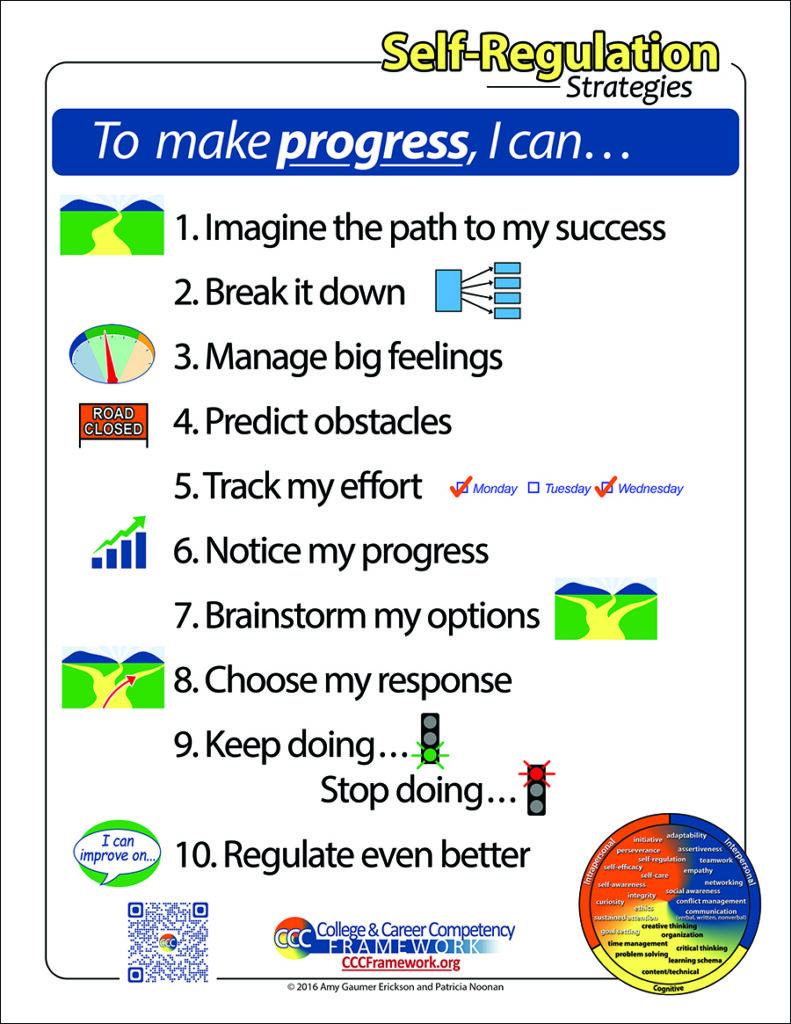
Watch the one-minute video What Is Self-Regulation? with your teen to learn more about what self-regulation is and how it can help them. Afterward, share an example of a time when you used self-regulation to improve your ability to do something or reach a goal. Then ask your teen to describe situations where they have used self-regulation before:
- What is a challenging goal or task that you recently completed?
- What motivated you to set the goal or complete the task?
- When you felt overwhelmed, frustrated, or wanted to give up, what did you do to keep going?
Explain that you are going to help them learn Self-Regulation Strategies that will improve their ability to choose actions that promote progress toward a goal and to think about actions they have used to self-regulate in the past that will help them with future challenges.
In this module, you will learn how to support your teen in improving their self-regulation through these four Self-Regulation Strategies: imagine the path to my success, brainstorm my options, keep doing … stop doing … , and regulate even better. Additional strategies are explained in the primary and intermediate parent guidance.

Imagine the Path to My Success
Your teen can self-regulate by imagining the path to their success. Learning this strategy helps them visualize actions they will take to get started on tasks and overcome challenges. They also think about the benefits of completing tasks and reaching goals. When teens imagine the path to their success, they should think about what it will look and feel like as they are progressing toward their goal, including the setbacks they could experience and ways they will persevere through such setbacks.
You can help your teen practice this strategy by asking them to think about something challenging they want or need to do. Then ask them to imagine themselves making progress. To help them determine some actions they will use to get started, ask them these questions:
- What do you imagine yourself doing to get started on your goal? What actions could help you make progress?
- Describe some challenges you could experience, including emotions you might experience, like frustration or discouragement. What actions could you take to overcome the challenges?
- When you complete the task or goal, what will you be able to do, and how will you feel?
After your child has brainstormed a few action steps for getting started and overcoming obstacles, ask them to jot them down on paper or keep them listed on their phone. After a couple of days, check in with your teen and discuss the effectiveness of their actions and their progress. If necessary, support your teen in revising their actions.
Emphasize that anytime they want to improve their ability to do something, complete a task, or work toward a goal, imagining the path to their success will help determine actions they could take to get started and plan ways to overcome setbacks they experience. When they practice imagining the path to their success, they will become better at self-regulation.

Brainstorm My Options
Students can improve their self-regulation by brainstorming their options. This strategy helps them think through daily in-the-moment decisions and see how their decisions impact their progress toward goals. When teens understand that their decisions directly affect their ability to make progress, they are more likely to make decisions that promote progress.
Explain to your teen that you are going to help them think through their daily choices and the impacts of those choices on their progress. Provide your teen with a personal example of a time when you had to make a quick decision that impacted your progress. For example, your goal might be to develop a healthier lifestyle. In that case, your goal would be affected by your decision to eat a second piece of cake or to watch another episode of your favorite show instead of going for a walk. These decisions aren’t wrong or inappropriate, but they do impact your progress.
Emphasize the fact that we all make in-the-moment decisions that affect our progress toward reaching a goal. There are times when our decisions are helpful to our progress and times when they hinder our progress. Rather than becoming discouraged and giving up after a decision that hinders progress, we can get back on track by using self-regulation.
Watch the two-minute video Brainstorm My Options & Choose My Response with your teen. After the video, ask:
- When have you made a decision that slowed your progress?
- Describe a time when you made a decision that promoted your progress.
- How would taking a few seconds to think about your options and how they could impact your progress toward a goal help you?
Help your teen practice the strategy brainstorm my options by discussing the following two scenarios:
You are saving money to buy a car, and your friend invited you to participate in a paintball tournament. The registration fee is $150, and you really want to join the tournament.
- Brainstorm your options. Name three choices you could make, and describe how each one would affect your progress toward buying a car.
- If you made the choice to participate in the tournament, how could you get back on track with saving your money?
Your grade in physics class is low, and you need to attend the after-school study session to avoid being placed on the ineligibility list for basketball. However, one your best friends was just released from the hospital, and the rest of your friends are going to visit him after school.
- Brainstorm your options. Name three choices you could make, and describe how each one would affect your goal of improving your physics grade so you can stay on the basketball team.
- If you made the choice to visit your friend after school, how could you get back on track with your physics grade?
Continue the conversation with your teen by asking them to describe some things they are working on and some quick decisions they could experience. Then ask them to describe actions that would help them resume progress. Explain that anytime they make a decision that slows their progress toward a goal or completing a task, rather than giving up, they should brainstorm options for getting back on track.
Keep Doing … Stop Doing …
When your teen is working toward a goal or trying to improve their ability to do something, it’s important that they reflect on whether their actions are helping them make progress. Your teen can learn to evaluate their actions by using the strategy keep doing … stop doing … Such reflection allows them to identify areas of improvement and adjust their actions to become more effective, improving their self-regulation.
Watch the two-minute video Keep Doing … Stop Doing … After the video, discuss why it is important to reflect on the actions you are using to make progress:
- How would reflecting on your actions as you were working on something help you improve?
- Describe a time when you adjusted your actions after you realized they weren’t helping you make progress.
Ask your teen to describe something they are currently learning to do. Then ask them to jot down a list of actions that are helping them make progress. For example, if your teen was working on making better grades, they might list completing homework in a timely manner, studying for tests, asking for help, and checking their answers before they submit exams.
Next, ask your teen to jot down some actions that could be hindering their progress. For actions that could hinder progress toward better grades, they might list staying up too late, waiting until the last minute to study for exams, and not focusing during class.
Finally, ask your teen to choose one action from the list of actions hindering their progress. Have them brainstorm ways to adjust that action. For example, instead of waiting until the last minute to study, they could adjust that action to studying each night for 15 minutes.
Summarize the conversation by reminding your teen that taking time to determine actions they should keep doing and those they should stop doing will improve their ability to evaluate their progress and develop effective ways to meet their goals.
Regulate Even Better
Your teen can improve their self-regulation by learning and practicing the strategy regulate even better. This strategy helps them evaluate which areas of self-regulation are their strengths and which areas challenge them. By focusing on strengthening challenging areas, your teen learns to evaluate their actions and determine better approaches for improving.
Watch the three-minute video Regulate Even Better with your teen. After the video, help your teen reflect on how this strategy can improve their self-regulation. Use these prompts to generate a meaningful conversation:
- How would you explain the strategy regulate even better?
- Why is reflecting on your strengths and challenges important?
Explain to your teen that we all have different areas of strength and challenge when it comes to self-regulation. For example, your friend may be very good at managing her emotions and rarely allow them to get in the way of what she needs to do, but you may have difficulty in this area. Managing emotions is an area that you could focus on improving so that you regulate even better the next time you experience strong emotions.
Tell your teen you are going to help them think about areas of self-regulation that are their strengths and areas that challenge them. Ask your teen:
- When you have something you need to do, do you have hard time figuring out how to get started? Do you procrastinate or avoid getting started?
- When you experience a challenge, can you manage big feelings, or do your emotions get in the way of what you need to do?
- Do you predict obstacles by thinking about setbacks you might experience when you are working toward a goal, or do you give up when you experience obstacles?
After your teen has determined which areas of self-regulation are their strengths and which areas challenge them, ask them to brainstorm techniques they could use to improve in their challenging areas. For example, if your teen determined that getting started on a task was challenging, some ideas for improving might be:
- breaking down a task into small, daily action steps
- noticing their progress by checking off actions as they complete them
- tracking their effort by timing how long they stay focused and avoid distractions
If your teen determined that managing big feelings while working on something was challenging, some ideas for improving might be:
- recognizing when they feel stressed or frustrated
- using calming techniques, like taking deep breaths or going for a walk, to minimize emotions
- recognizing and reframing negative thoughts about the task (e.g., “This is too hard; I cant’ to this”) to be more positive (e.g., “This will become easier with practice; I’m getting better each time a try”)
If your teen determined that predicting obstacles was challenging, some ideas for improving might be:
- predicting obstacles by brainstorming possible setbacks and planning how to overcome them
- choosing their response to daily setbacks by remembering to choose actions that help them make progress
Finally, ask your teen to describe a new thing they want or need to learn. Then ask them to determine what they will do to address their challenging area. Check in with your teen after a few days and discuss if they are regulating even better by focusing on improving their challenging areas.
Emphasize that anytime they have something they need to do, they should think about their areas of strength and challenge and ways they will focus on improving their challenging areas so they regulate even better with each task they need to complete.
Next Steps
- Help your teen practice imagining the path to their success by asking them to describe what it will look and feel like as they are working toward a goal. Remind them to think about how they will manage big feelings and what they will do to overcome setbacks they are likely to experience.
- You can support your teen in practicing the strategy brainstorm my options by reminding them that they will have daily in-the-moment decisions to make while they are working toward a goal and that some decisions will help them make progress while others will not. Getting back on track after they make a decision that limits their progress is an important part of practicing self-regulation.
- Help your teen practice the strategy keep doing … stop doing … by facilitating a conversation about their progress toward a goal. Ask them to determine which actions are most effective and which actions need to be adjusted so that they continue to make progress.
- You can support your teen in practicing the strategy regulate even better by reflecting with them after they have completed a goal. Which areas of self-regulation could they do better next time? What will they do to improve in their challenging areas?