
Does your child become upset when things don’t go as planned? Your child may struggle with managing their time or their emotions. They may feel anxious about a test at school or participating in a sporting event. Teaching your child Self-Regulation Strategies can improve your child’s ability to set goals, overcome obstacles, and manage their emotions.
Definition
Self-regulation is a proactive, self-directed process for attaining goals, learning skills, managing emotional reactions, and accomplishing tasks (Gaumer Erickson & Noonan, 2022).
Students use Self-Regulation Strategies to increase their independence and manage emotional reactions.
Student Impacts
Teachers providing self-regulation instruction and classroom practice observe student growth, including:
- Improved ability to set realistic goals, monitor progress, and evaluate results
- Increased sense of control and awareness of their academics
- Improved understanding of the relationship between actions and progress
Research in elementary and secondary education identifies proven student impacts from teaching self-regulation.
- Learning Self-Regulation Strategies increases students’ academic performance, especially if students are taught when, why, and how they should use certain strategies (Theobald, 2021).
- Students who self-regulate earn better grades and higher scores on standardized assessments (Hattie & Zierer, 2018).
- By receiving explicit instruction in self-regulation, students can better regulate their emotions, leading to decreases in negative internalizing and externalizing behaviors (Finlon et al., 2015).
- Students who use self-regulation recognize more ways to sustain their attention, allowing them to resist common distractions and show more resilience when faced with challenges (Mrazek et al., 2018).
Watch the one-minute video What Is Self-Regulation? with your child to learn more about what self-regulation is and why it is important. Afterward, share examples of times when you used self-regulation to improve your ability to do something or reach a goal. Use the following questions to ask your child to describe situations where they have used self-regulation before:
- What is something you have learned to do that was very challenging?
- What did you do to start learning it?
- When you felt frustrated and wanted to give up, what did you do to keep learning it?
Explain that you are going to help them learn Self-Regulation Strategies so they can understand how to get started when they have something challenging they want or need to do and how to manage their emotions when they experience setbacks.
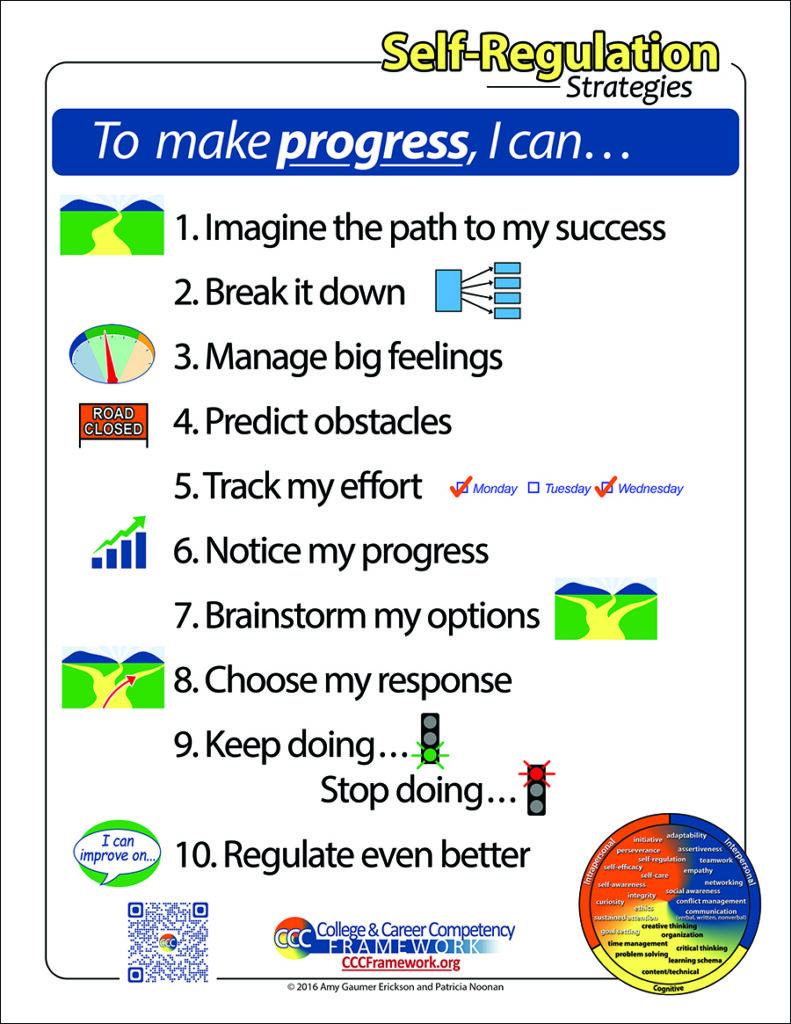
In this module, you will learn how to support your child in improving their self-regulation through these four Self-Regulation strategies: break it down, manage big feelings, track my effort, and notice my progress. Additional strategies are explained in the primary and secondary parent guidance.
Break It Down
When your child has something new to learn or a task they want to complete, you can help them understand how to get started and focus on their progress by teaching them the strategy break it down. Breaking it down helps children determine things they can do to get started on a task and make progress rather than becoming overwhelmed when they think about the task as a whole. When they focus on smaller action steps, their self-regulation is improved because it makes the goal more manageable and helps them stay focused on smaller, incremental actions.
Ask your child:
- Have you ever needed to do something, like read an entire book or improve your ability to play a sport, but when you thought about it, you felt overwhelmed by how big the task was?
Tell your child that you are going to help them learn how to get started on a task so that they make progress and don’t feel so overwhelmed. Compare breaking it down to climbing a ladder: When you climb a ladder, you climb it one rung at a time. With each rung, you are getting closer to the top. When you have a task to complete, you can start by doing one small thing at a time, and as you complete each small step, you are making progress toward completing the task.
Watch this two-minute video Break It Down with your child to help them understand the strategy. After the video, ask:
- How would you describe the strategy break it down?
- How can breaking down a big task help you?
Explain to your child that you are going to help them practice the strategy break it down by breaking down something big that they currently want or need to do. Ask them to think about a few actions they could do to get started. For example, if your child needs to read a chapter book by the end the week, ask:
- What is the first thing you could do?
[Possible response: decide on a book and check it out from the library.] - What is the next thing you could do?
[Possible response: read the first chapter, read the first few pages.] - What could you do after that?
[Possible response: read 10 minutes every day.]
You can ask your child to write each step down and check it off as they complete it. After a few days, ask your child to reflect on their progress by reviewing each step they have completed. You can help them continue to make progress by helping them brainstorm additional steps if needed.
It’s important that your child connects the strategy break it down to any type of task they need to complete. Breaking it down can be used for academics, extracurriculars, and improvement in their ability to do something. Ask:
- What are some other things that you would like to learn or do?
- How can you break down those tasks? What are some smaller actions you could do to get started?
Emphasize that anytime a task seems big, they can break it down by thinking of smaller action steps and staying focused on completing those action steps. For example, when they have a lot of homework to complete, they can break down their homework into subjects and complete one subject at time. Encourage your child to think about how they will manage their emotions when they feel overwhelmed. Ask them to include action steps, like taking a deep breath or thinking positive thoughts, to help them manage their emotions as they are working toward a goal.
Manage Big Feelings
When children learn to manage big feelings they experience while working toward a goal or improving their ability to do something, they are increasing their self-regulation. Children can learn techniques to minimize the effects of strong emotions on their mind and body so that they can stay focused and make progress rather than becoming derailed by their emotions.
Managing big feelings helps children improve their self-regulation because they understand that how they react to big feelings is a choice and their reaction will impact the outcome. For example, choosing to use calming techniques to minimize emotions and stay focused will help them make progress, while allowing emotions like frustration to take over will slow their progress and could lead to them giving up.
The first step in helping your child learn to manage big feelings is to help them recognize the signals their body is sending them when they have strong feelings. Describe those signals as times when their mind and body feel fast or slow. For example, their mind and body might feel fast when they experience big feelings, like anger or frustration. The signals they experience might be their cheeks getting warm and their heart beating faster. Their mind and body might feel slow when they experience emotions like boredom. Those signals might include feeling tired, sluggish, and unfocused.
Learning techniques to move their mind and body back to just the right speed—like taking deep breaths, going for a walk, or talking to someone about their feelings—will help them practice managing their big feelings.
Watch the three-minute video Manage Big Feelings with your child. After the video, use these prompts to generate a meaningful discussion:
- Describe a time when your mind and body felt fast. What sensations did you notice? What thoughts did you have?
- Describe a time when your mind and body felt slow. What sensations did you have? What thoughts did you have?
- How could learning to manage big feelings help you?
Explain to your child that one way to improve their ability to manage big feelings is to identify times when they typically experience big feelings and plan what they will do to minimize their emotional reaction the next time they are in that situation. Ask your child:
- When do you usually have big feelings and your mind and body feel fast?
- When do you usually have big feelings and your mind and body feel slow?
Prompt your child to think about specific times of day or situations when their mind and body feel fast, like when they lose a basketball game during recess or when their writing assignment seems long and overwhelming. Next, prompt your child to identify situations when they might have big feelings that are slow, like right after lunch or at the end of the school day. For each situation, help your child brainstorm two different techniques they will use to move their mind and body back to just the right speed.
- What are some things you can do to manage big feelings when your mind and body feel fast?
(e.g., take deep breaths, go for a walk, think positive thoughts) - What are some things you can do to manage big feelings when your mind and body feel slow?
(e.g., go for a walk, get a drink of water, do some stretches)
Discuss how well each technique worked and brainstorm additional techniques if necessary. Emphasize that anytime their mind and body feel fast or slow, they can manage their big feelings by moving them back to just the right speed. Keeping their mind and body at just the right speed helps them make progress and stay focused on what they need to do.

Track My Effort
The Self-Regulation Strategy track my effort helps children understand that their level of effort is connected to how much progress they make. Teaching your child to track their effort will help them determine when they are focused and putting forth effort and when they are distracted and need to put forth more effort.
Provide your child with an example of something you did or learned by putting forth effort. It might be learning a new program at work or improving your ability to prepare a complex recipe. Explain how you tracked your effort. Describe the actions you used that helped you, like staying focused for shorter periods of time or working on the task when you were most alert. Afterward, ask your child:
- What is something you did by putting forth a lot of effort?
- How did you know you were using effort?
Watch the two-minute video Track My Effort & Notice My Progress with your child. After the video, discuss why tracking effort can help improve their ability to do something:
- What do you do when you track your effort?
- How will tracking your effort help you?
Emphasize that tracking your effort is thinking about how hard you are trying to do something. Explain to your child that learning to recognize when they aren’t focused and their effort is low will help them change their actions so that they increase their effort and continue to make progress.
Tell your child you are going to help them practice tracking their effort. Ask them to choose something they want to work on, like improving in a sport, remembering to complete their chores, or waking up earlier for school. Then help them brainstorm two or three action steps they will use to improve, like shooting baskets for ten minutes each day or writing down each chore. Next, help your child choose a tool for tracking their effort. Tools could include:
- Checklist—marking off completed steps
- Rating scale—rating how much effort you used (e.g., 1 = low effort; 5 = high effort)
- Timeline—using a calendar to show the end date and marking each day that you practiced
- Timer—recording how much time you practiced
- Tallies—noting each time you managed emotions, practiced, or used a strategy
- Journal—briefly writing about your effort
Spend a few minutes each day talking to your child about their level of effort on the task. Remind them that tracking their effort on things at school, home, or extracurricular activities will help them learn to think about how hard they are trying to do something and know what to do when they aren’t putting forth enough effort.

Notice My Progress
The strategy notice my progress helps children reflect on their actions and determine if new actions are needed while they are working toward a goal. By thinking about their progress and what they could do to continue making progress, children improve their self-regulation. When children don’t stop and notice their progress, they are more likely to become frustrated by the lack of progress and give up.
Watch two two-minute video Track My Effort & Notice My Progress again with your child. This time ask them to focus on understanding the strategy notice my progress. After the video, discuss how the strategy helps them meet a goal or improve their ability to do something.
- What does it mean to notice your progress?
- What could happen if you didn’t stop and notice your progress?
- When have you made progress on something? How did you know you were making progress?
Emphasize that when they have something they want or need to do, noticing their progress will help them determine if their actions are working or if they need to develop new action steps. Explain that if they aren’t making progress toward their goal, it’s okay to try new and different ways to get there.
A fun way to help your child notice their progress is to look through old photos or documents. For example, if you have school papers from kindergarten when your child was just learning to write their name or numbers, compare those to more current school papers and discuss what they did to make progress.
Tell your child that you are going to help them practice the strategy notice my progress. Ask them to describe something they are currently working on or learning. This can also be the task you discussed in the previous section, track my effort. Then tell them that each week you will use your cell phone to take a short video of them. For example, if your child wants to improve their ability to get up earlier for school, you might take a short video of them getting up and note the time. After a few weeks, compare the videos and discuss their progress in getting up earlier.
Remind them that when they are working toward a goal, they should take time to reflect on their progress and determine how much progress they have made. When they track their effort and notice their progress, they can adjust their actions if needed rather than getting stuck.
Next Steps
- Help your child practice breaking it down by prompting them to write down smaller actions they will complete each time they have something they need to do. Remind them that emotions can be obstacles too and that their action steps should also include steps for managing emotions.
- Help your child practice the strategy manage big feelings by reminding them that how they respond to big feelings is a choice and that their choices will impact their progress toward a goal. Anytime your child experiences big feelings, ask them to describe the speed of their mind and body, whether fast or slow, and the sensations, like a racing heart or sweaty palms, they experience. Help them determine two calming techniques they will practice for times when their mind and body feel fast or slow.
- You can support your child in practicing the strategy track my effort by asking them to describe the actions they used while working on something. Ask them to reflect on how often they became distracted and what they could do to avoid distractions. Determine if there is a time of day or situation where their effort is lacking and help them plan ways to stay focused on their effort.
- Help your child practice the strategy notice my progress by discussing things they have already done that required progress, like learning to ride a bike, improving their ability to complete more math problems in a set time, or reading longer passages or books. Ask them to describe the actions they used to make progress in the past and determine if they could use similar actions to make progress on something new.